
1. Introduction
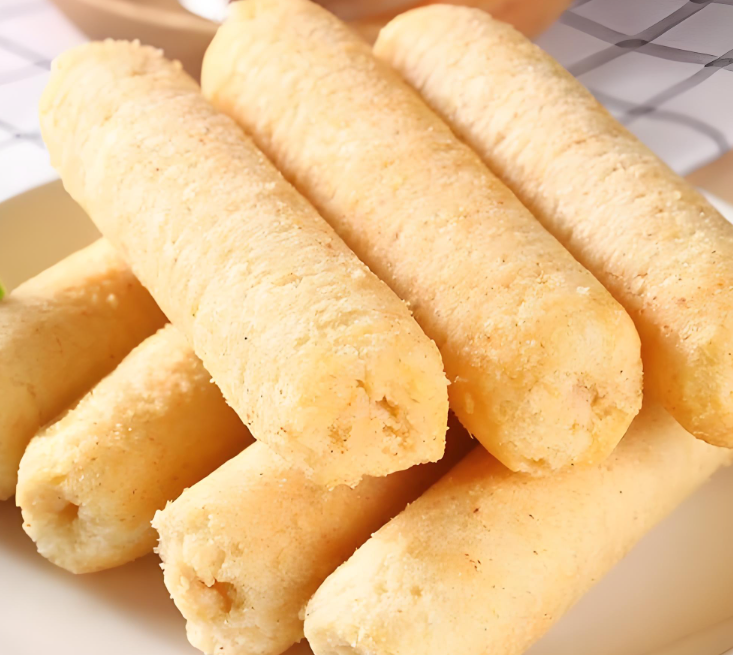
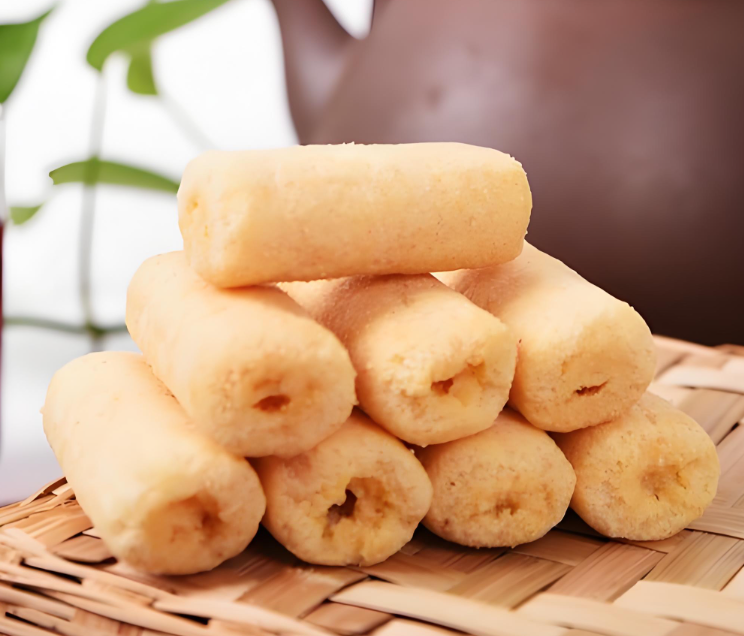
Sandwich rice snacks, also known as filled puffed rice rolls or “sandwich rice crackers”, are popular extruded snack foods consisting of a crispy hollow puffed rice tube filled with a creamy or pasty filling such as chocolate, peanut butter, cheese, or fruit-flavored cream. These snacks are favored for their light, crispy texture and rich flavor, achieved through a combination of extrusion technology and filling injection. Compared to traditional fried snacks, extruded sandwich rice snacks are typically lower in oil content and can be formulated to include functional ingredients like dietary fiber, vitamins, and minerals.
This article provides a comprehensive overview of the processing technology for sandwich rice snacks, covering raw material preparation, extrusion puffing, filling injection, drying, seasoning, and packaging.
2. Raw Materials and Formulation
2.1 Shell Ingredients (Puffed Tube)
The outer shell of sandwich rice snacks is typically made from a blend of cereal flours. Common ingredients include:
- Rice flour or broken rice – primary ingredient providing the characteristic light texture
- Corn flour (corn grits) – adds crispness and a golden color
- Wheat flour – improves structural integrity
- Sugar – contributes to sweetness and browning during baking
- Salt – enhances flavor
- Calcium carbonate – sometimes added for calcium fortification
- Water – added during mixing to reach optimal moisture content (typically 12–14%)
2.2 Filling Ingredients
The filling is the “sandwich” component that provides flavor contrast and creaminess. Common filling formulations include:
| Filling Type | Primary Ingredients |
|---|---|
| Sweet cream | Sugar, fat (palm oil), milk powder, flavorings |
| Chocolate | Cocoa powder, sugar, fat, emulsifiers |
| Peanut butter | Peanut paste, sugar, salt, stabilizers |
| Fruit flavor | Fruit powder or concentrate, sugar, fat, acidulants |
| Savory (e.g., beef) | Meat extract, salt, spices, fat |
Emulsifiers such as soy lecithin are often added to filling formulations to improve smoothness, stability, and mouthfeel.
3. Processing Equipment
A complete sandwich rice snack production line consists of several interconnected machines:
| Equipment | Function |
|---|---|
| Mixer (powder blender) | Dry mixing of raw materials |
| Screw feeder | Conveys mixed powder to extruder |
| Twin-screw extruder | Puffs and shapes the hollow tube |
| Filling injector (injection pump) | Injects filling into the hollow snack |
| Cutting machine | Cuts the filled tube into uniform lengths |
| Elevator/lift conveyor | Transfers product to oven |
| Multi-layer oven | Dries and bakes the product |
| Oil sprayer / Seasoning drum | Applies oil and seasoning |
| Cooling conveyor | Cools product before packaging |
| Packaging machine | Seals finished product |
Industrial twin-screw extruders typically operate at production capacities ranging from 120–250 kg/h for mid-sized lines, with larger systems reaching 300–450 kg/h.

4. Step-by-Step Processing Technology
Step 1: Raw Material Preparation and Mixing
The dry ingredients (rice flour, corn flour, sugar, salt, etc.) are weighed according to the formulation and loaded into a powder mixer. extruder snacks The ingredients are blended thoroughly for 5–10 minutes to ensure uniform distribution. Water is then added gradually during mixing to achieve a homogeneous moist powder with moisture content around 12–14%.
For specialty products, additional ingredients may be incorporated at this stage:
- Soy lecithin (0.5–0.6%) – improves expansion by reducing melt viscosity
- Dietary fiber sources (e.g., fruit pomace powder) – enhances nutritional value
Step 2: Extrusion Puffing
The conditioned powder is fed into a twin-screw extruder via a screw feeder. Inside the extruder barrel, the material undergoes several phases:
- Conveying and compression – the powder moves forward and is compacted
- Shearing and heating – friction and external heating raise the temperature to 120–150°C (sometimes up to 130–150°C at the die)
- Melting and gelatinization – starch granules absorb water, swell, and gelatinize
- Pressurization – pressure builds to 400–500 psi as material moves toward the die
- Expansion – as the melt exits the die, superheated steam flashes off, causing instant puffing into a hollow tube. The die shape determines the cross-section (circular, star-shaped, etc.)
The extrusion parameters are critical to product quality. High temperatures and shear forces increase expansion ratio, while excessive moisture can reduce crispness. The resulting puffed tube is hot, pliable, and hollow.

Step 3: Filling Injection
Immediately after exiting the extruder die, the hollow puffed tube passes through a filling injection unit (also called a creaming or sanding pump). A precision pump injects the prepared filling (heated to a pumpable consistency) into the center of the tube through a slender nozzle.
The injection process must be carefully synchronized with extrusion speed to ensure:
- Even filling distribution
- Prevention of rupture or leakage
- Consistent fill weight per piece
For high-quality products, the filling may comprise 20–35% of the total product weight depending on the formulation.
Step 4: Cutting to Length
After injection, the filled tube moves continuously into a rotary cutting machine. The cutting blades slice the filled rope into individual pieces at adjustable lengths, typically ranging from 2 cm to 10 cm depending on the desired final product size. The cut pieces then fall onto a conveyor leading to the oven.
Step 5: Drying and Baking
The cut, filled pieces are transferred via an elevator/lift conveyor into a multi-layer electric or gas oven. The oven performs several functions:
- Removes residual moisture – reducing moisture content to 3% or less for extended shelf life
- Sets the filling – heat firms the filling so it does not leak during packaging
- Improves texture – enhances crispiness of the shell
- Promotes flavor development – the Maillard reaction adds roasted notes
Oven temperatures typically range from 100–200°C, with precise control maintained through adjustable heating zones. Residence time in the oven varies from 3 to 10 minutes depending on product size and oven design.
Step 6: Oil Spraying and Seasoning
After baking, the hot product may pass through an oil sprayer where edible oil (palm oil, sunflower oil, etc.) is atomized onto the surface. The oil:
- Enhances mouthfeel and sheen
- Serves as an adhesive for powdered seasonings
The oiled product then enters a tumbling seasoning drum (e.g., octagonal or round drum), where powdered seasoning blends (cheese, barbecue, sour cream & onion, etc.) are applied evenly. Seasoning addition rates are typically 3–8% of product weight.
Step 7: Cooling
The seasoned product is conveyed through a cooling conveyor (often with perforated belts and fans) to bring the temperature down to near ambient levels. Cooling is essential to:
- Prevent moisture condensation inside packaging
- Harden the product for crisp texture
- Allow immediate packaging without heat damage to film
Step 8: Packaging
The cooled sandwich rice snacks are fed into a horizontal pillow-type packaging machine that forms, fills, and seals individual bags or larger flow-pack wrappers. Modified atmosphere packaging (MAP) with nitrogen flushing is often employed to extend shelf life by reducing oxidation of fat and filling.
5. Key Process Parameters
| Parameter | Typical Range | Impact |
|---|---|---|
| Extruder barrel temperature | 120–150°C | Affects expansion and texture |
| Die pressure | 400–500 psi | Controls puffing ratio |
| Feed moisture | 12–14% | Higher moisture reduces expansion |
| Oven temperature | 100–200°C | Drying rate and browning |
| Final product moisture | ≤ 3% | Shelf life and crispness |
| Filling content | 20–35% of total weight | Flavor and cost balance |
6. Quality Control Considerations
Key quality indicators for sandwich rice snacks include:
- Shape and appearance – uniform length, intact shell without cracks, no filling leakage
- Texture – crispy and light, not hard or soggy
- Filling distribution – centered, consistent amount per piece
- Flavor – balanced, no off-flavors from oxidized oil
- Microbiological safety – low water activity prevents microbial growth
Common defects and causes:
- Brittle or broken pieces – excessive drying or over-expansion
- Filling leakage – misaligned injector nozzle or excessive filling pressure
- Pale or soft texture – insufficient baking or low extrusion temperature
- Soggy product – inadequate drying or poor cooling before packaging
7. Variations and Innovations
7.1 Multi-Color and Decorated Snacks
Some manufacturers incorporate colored wafer, oat, or rice flakes into the outer coating of the product to create visually appealing snacks with speckled patterns resembling herbs or spices. These colored flakes retain their appearance even after high-temperature baking or frying.
7.2 Functional Ingredients
Recent innovations include incorporating fruit pomace (e.g., blueberry pomace from juice processing) into the shell formulation to add dietary fiber, anthocyanins, and natural color to the product. Similarly, calcium carbonate and other micronutrients can be added for nutritional fortification.
7.3 Alternative Fillings
Beyond traditional sweet and savory fillings, manufacturers have developed products filled with:
- Fermented cheese cream – for tangy dairy notes
- Meat paste or meat extract – for protein-rich savory snacks
- Chocolate compound coatings – applied externally for premium products
8. Conclusion
The processing technology of sandwich rice snacks represents a mature and efficient application of twin-screw extrusion technology. The fully automated production line—from raw material mixing to finished packaging—enables high output with consistent quality. Critical steps include precise control of extrusion parameters for optimal puffing, accurate filling injection to avoid leakage, and thorough drying to ensure crispness and long shelf life.
Modern innovations focus on incorporating functional ingredients (fiber, vitamins, minerals) and developing novel flavor profiles to meet evolving consumer demands for both indulgence and nutrition. With proper equipment configuration and process control, sandwich rice snacks offer manufacturers a versatile, profitable product category suitable for global markets.
 Arabic
  English
  Russian
  Spanish
  Italian
  Portuguese
  German
  French
  Japanese
  Moroccan Arabic
  Persian
  Belarusian