
Introduction
The global pet food industry is booming, with the cat food segment experiencing particularly robust growth. Driven by humanization trends (treating pets as family), premiumization (demand for high-protein, grain-free, natural recipes), and the expansion of e-commerce, investing in a cat food processing plant can be a highly lucrative venture. cat food machine However, it requires significant capital, regulatory knowledge, and operational expertise.
This guide provides a step-by-step roadmap for potential investors, from market analysis to exit strategies.
Phase 1: Market Research & Feasibility Analysis
Before spending a dollar, validate the opportunity.
1.1 Understand Market Segments
- Economy (Value): Low-cost, basic nutrition. High volume, low margin. Dominated by giants.
- Premium: Natural ingredients, no artificial preservatives. Growing fast.
- Super-Premium: High meat content, grain-free, novel proteins (duck, rabbit, venison). Highest growth and margins.
- Therapeutic/Veterinary: Prescription diets for health conditions. Requires R&D and vet partnerships.
1.2 Analyze Your Target Geography
- Mature markets (NA, EU, Japan): High spending per pet, cat food machine saturated but open to innovation (e.g., insect protein, fresh/frozen).
- Emerging markets (China, Brazil, SE Asia): Rapidly growing middle class, rising pet ownership, less brand loyalty.
1.3 Competitive Landscape
- Identify local and international players (Mars, Nestlé Purina, Colgate-Palmolive (Hill’s), J.M. Smucker).
- Find whitespace: e.g., locally sourced ingredients, eco-friendly packaging, small-batch fresh cat food.
Key Feasibility Questions:
- What is the current and projected demand in your target region?
- Can you compete on price, quality, or differentiation?
- Do you have access to reliable, affordable protein and grain sources?
Phase 2: Business & Financial Planning
2.1 Choose Your Business Model
| Model | Description | Pros | Cons |
|---|---|---|---|
| Greenfield Plant | Build from scratch | Full control, optimized design | Highest cost, longest time to revenue |
| Brownfield Acquisition | Buy existing plant | Existing permits, staff, customers | Possible obsolescence, hidden issues |
| Co-packing (Contract manufacturing) | Produce for other brands | Lower risk, steady revenue | Lower margins, less brand equity |
| Private Label | Produce for retailers (e.g., store brand) | Volume, no marketing spend | Price pressure, no brand ownership |
2.2 Estimate Startup & Operating Costs
Capital Expenditure (CAPEX – upfront):
- Land & building: $2M – $10M+ (depending on location/size)
- Processing equipment: $1.5M – $5M (extruders, dryers, mixers, coating systems, packaging lines)
- Utility systems: $500k – $1.5M (boilers, wastewater treatment, HVAC)
- Regulatory & lab setup: $200k – $500k
Operating Expenditure (OPEX – monthly):
- Raw materials (meat meals, grains, fats, vitamins): 50-65% of revenue
- Labor (production, QC, management, sales)
- Utilities, maintenance, packaging, logistics
- Marketing & distribution
2.3 Financial Projections (3-5 years)
- Gross margin target: 25-40% (super-premium can reach 50%)
- Net margin target: 10-20% after all costs
- Breakeven volume: Typically 40-60% of plant capacity
- ROI timeline: 4-7 years for greenfield; 2-4 years for co-packing or acquisition
2.4 Funding Sources
- Debt: Bank loans, SBA (or equivalent), equipment financing (requires collateral)
- Equity: Angel investors, venture capital (pet-focused funds), cat food machine strategic partners
- Grants/subsidies: Some regions offer agribusiness or rural development grants
Phase 3: Legal & Regulatory Compliance
Cat food is highly regulated in most countries. Non-compliance can shut you down.
3.1 Key Regulatory Bodies (USA example)
- FDA (CFSAN): Regulates animal feed, including pet food (Food Safety Modernization Act – FSMA)
- AAFCO (Model bill): Provides nutritional standards; state-level enforcement
- USDA (if using meat/poultry): Some oversight on ingredients
- State Departments of Agriculture: Product registration, facility inspection
3.2 Critical Compliance Requirements
- Facility registration with FDA
- Good Manufacturing Practices (GMPs) for animal food
- Hazard Analysis & Risk-Based Preventive Controls (HARPC) – a formal food safety plan
- Nutritional adequacy statement (e.g., “complete and balanced for adult cats”)
- Ingredient labeling – accurate, no false claims (e.g., “grain-free” must be true)
- Traceability & recall plan – must be able to trace one batch from supplier to customer
3.3 International Standards (if exporting)
- EU: EC 183/2005 (hygiene), 767/2009 (labeling), EFSA oversight
- China: GAC registration, MOARA permits
- Canada: CFIA Safe Food for Canadians Act
Tip: Hire a pet food regulatory consultant early (cost: $10k–$50k) – cheaper than a recall.
Phase 4: Plant Setup & Operations
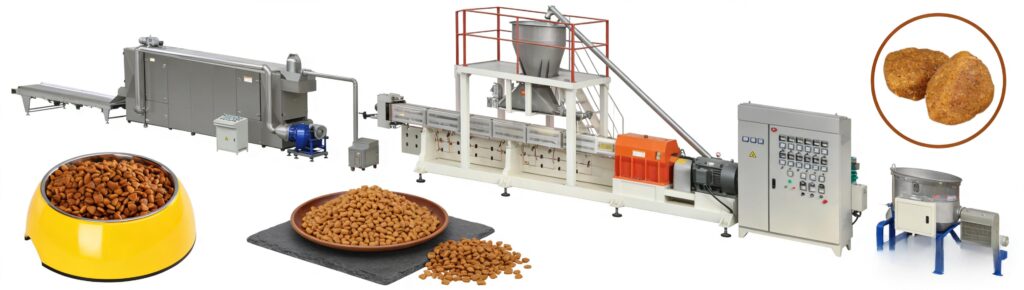
4.1 Production Process Overview (Dry Kibble – most common)
- Raw material receiving (meat meals, grains, liquids)
- Grinding & batching (mix according to recipe)
- Extrusion (cook under high heat/pressure, shape kibble)
- Drying (reduce moisture to <10% for shelf stability)
- Coating (spray fats, flavors, or probiotics)
- Cooling & screening (remove fines)
- Packaging (bags, pouches, or boxes)
- Metal detection / X-ray (critical safety step)
Alternative processes: baking, freeze-drying, retort (wet food), cold-pressing.
4.2 Facility Design Priorities
- Segregation: Raw ingredient storage → production → finished goods (prevent cross-contamination)
- Sanitation: Easy-clean surfaces (stainless steel), floor drains, CIP (clean-in-place) systems
- Pest control: Sealed entry points, air curtains, routine monitoring
- Waste management: Grease traps, wastewater treatment (high BOD from fats/proteins)
4.3 Equipment Selection
- Extruder: The heart of the plant. Single-screw (cheaper, less flexible) vs. twin-screw (expensive, better for high-meat/grain-free recipes).
- Dryer: Rotary or belt dryer – energy efficiency is key.
- Coater: Vacuum coating for deep fat infusion (improves palatability).
- Packaging: Vertical form fill seal (VFFS) machines with nitrogen flush (extends shelf life).
Recommendation: Buy used/reconditioned equipment from reputable dealers (e.g., Perry, Federal Equipment) to reduce CAPEX by 40-60%.
4.4 Staffing Requirements (for a medium plant: 10,000 tons/year)
- Plant manager (1)
- Production supervisor (2)
- Extrusion/dryer operator (3 per shift)
- Quality control technician (2-3)
- Maintenance mechanic (2)
- Warehouse/logistics (3-4)
- Sales & admin (2-4)
Phase 5: Quality Assurance & Food Safety
Cat food safety failures (e.g., Salmonella, aflatoxin, nutritional imbalances) can kill cats, destroy your brand, and lead to lawsuits or prison time.
5.1 Mandatory Programs
- HACCP (or HARPC) – identify and control biological, chemical, physical hazards
- Supplier approval program – audit all raw material suppliers
- Incoming ingredient testing (moisture, protein, pathogens, mycotoxins)
- Finished product testing (nutritional analysis, pathogen screen)
- Environmental monitoring (swab for Listeria, Salmonella in wet zones)
5.2 Critical Cat-Specific Risks
- Taurine deficiency – Cats cannot synthesize taurine; must be added and verified. Deficiency causes blindness and heart failure.
- Vitamin D toxicity – Over-supplementation causes kidney failure.
- Methionine / urinary pH – Imbalances lead to struvite crystals (urinary blockage, fatal if untreated).
Investment tip: A quality lab (in-house or contract) is non-negotiable. Budget $100k–$300k for basic analytical equipment (HPLC for vitamins, NIR for proximate analysis).
Phase 6: Sourcing & Supply Chain
6.1 Ingredient Strategy
| Ingredient Type | Typical Sources | Volatility | Notes |
|---|---|---|---|
| Meat meals (chicken, fish, lamb) | Rendering plants | High (commodity prices) | Build relationships with multiple suppliers |
| Grains (rice, corn, barley) | Agricultural co-ops | Medium | GMO vs. non-GMO affects premium positioning |
| Fats (chicken fat, fish oil) | Rendering, fisheries | High | Palatability and omega-3 source |
| Vitamins/minerals | Premix manufacturers | Low | Buy custom premix from reputable company (e.g., DSM, Trouw) |
6.2 Packaging
- Bags: Multi-wall paper with plastic liner (most common)
- Sustainable options: Recyclable mono-material PE, paper-based, compostable (premium differentiator)
- Lead times: 4-12 weeks for custom printed bags
6.3 Logistics
- Inbound: Bulk trucks for grains/meals, tankers for liquids
- Outbound: LTL or full truckload to distributors, e-commerce warehouses, or retailers
Phase 7: Sales, Marketing & Distribution
A great product with no distribution is a failure.
7.1 Go-to-Market Channels
| Channel | Pros | Cons |
|---|---|---|
| Direct-to-consumer (DTC) via website | Highest margin, brand control, customer data | High marketing cost (Facebook/Google ads), shipping expense |
| E-commerce (Amazon, Chewy, Tmall) | Huge reach, logistics support | High fees, limited brand loyalty |
| Brick & mortar (pet specialty, grocery) | Tangible shelf presence, impulse buys | Slotting fees, returns, competition for shelf space |
| Veterinary clinics | High trust, therapeutic positioning | Long sales cycle, requires vet education |
| International distributors | Volume growth | Logistics complexity, regulatory hurdles |
7.2 Marketing Essentials
- Brand story: “We use locally farmed chicken and non-GMO vegetables.”
- Packaging design: Clear windows, beautiful photography, nutritional claims (e.g., “95% animal protein”)
- Sampling program: Cats are picky – free samples drive trial.
- Influencer/vet endorsements: Critical for credibility.
7.3 Pricing Strategy
- Cost-plus: Raw material cost × 3–4× for retail price (standard industry multiple)
- Value-based: If your food prevents urinary issues, price near premium veterinary diets.
Example: Production cost = $1.50/lb → wholesale $2.50/lb → retail $5.00–$6.00/lb.
Phase 8: Risk Management
8.1 Major Risks & Mitigations
| Risk | Likelihood | Impact | Mitigation |
|---|---|---|---|
| Raw material price spike | High | High | Forward contracts, ingredient substitution flexibility |
| Product recall | Medium | Catastrophic | Rigorous QC, recall insurance ($1M+ coverage) |
| Equipment breakdown | Medium | High | Spare critical parts, preventive maintenance contract |
| Regulatory change | Low | Medium | Join industry associations (PFI, AFIA) for early warning |
| New competitor | High | Medium | Build brand loyalty, innovate continuously |
8.2 Insurance Checklist
- General liability
- Product liability (specific to pet food – expensive but mandatory)
- Property & business interruption
- Recall insurance
- Workers’ compensation
Phase 9: Exit Strategy
Plan your exit before you enter.

| Exit Route | Typical Timeline | Multiple (EBITDA) | Best For |
|---|---|---|---|
| Strategic sale (to Mars, Nestlé, etc.) | 5-10 years | 6–12x | Scaled, profitable plants with brands |
| Private equity | 3-7 years | 5–8x | Rapidly growing, efficient operations |
| Management buyout | 5-8 years | 4–6x | Founders wanting gradual retirement |
| IPO | 7-10+ years | Varies | Large-scale, public markets |
Maximizing exit value: Build a strong brand, audited financials, diverse customer base (not reliant on one retailer), and long-term supplier contracts.

Phase 10: Final Checklist Before Investing
✅ Market – Is there unmet demand for your specific cat food (e.g., fresh, insect-based, renal care)?
✅ Capital – Do you have 20-30% over estimated costs for overruns?
✅ Team – Do you have a production manager with pet food extrusion experience? (Do not rely on general food experience alone.)
✅ Permits – Have you confirmed zoning, environmental, and all regulatory approvals?
✅ Offtake – Do you have letters of intent from distributors or retailers for at least 30% of capacity?
✅ Differentiation – Is there a real, defensible reason a cat owner should choose you?
Conclusion
Investing in a cat food processing plant is not for the faint of heart. It is capital-intensive, operationally complex, and heavily regulated. However, for those who execute well, it offers recurring demand (people feed their cats twice a day, every day), strong margins in premium segments, and multiple exit opportunities.
 Arabic
  English
  Russian
  Spanish
  Italian
  Portuguese
  German
  French
  Japanese
  Moroccan Arabic
  Persian
  Belarusian