
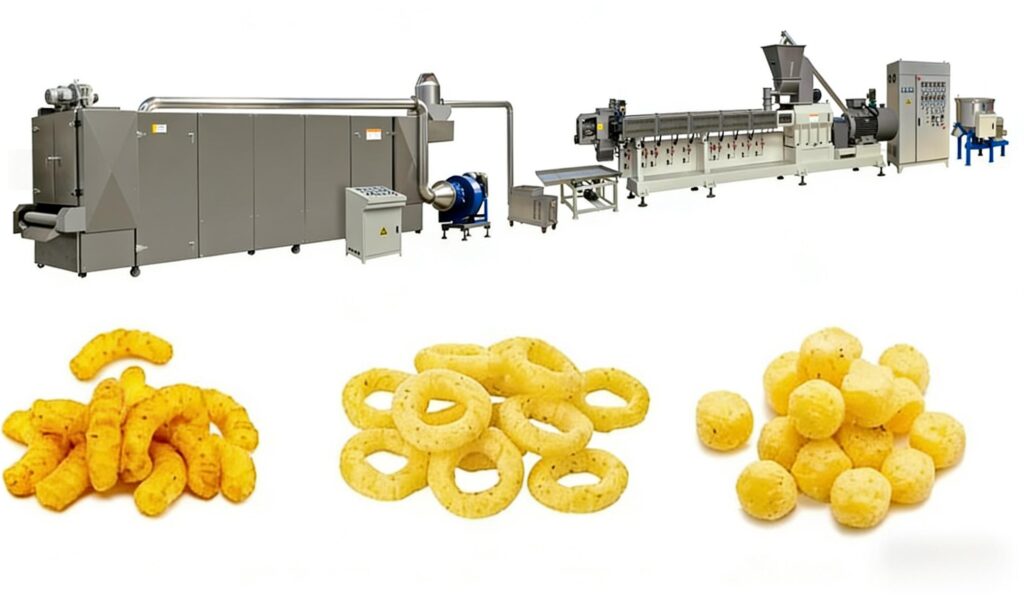
Puffed snacks seem effortless on the shelf—light, crisp, uniform—but the extrusion line behind them is a narrow window of stability. The same screw that must cook, shear, and shape a starch matrix in seconds is also prone to surging, clogging, and producing dense, hard pellets instead of airy pillows. Most production failures cluster around a few recurring culprits: unstable feeding, moisture and temperature imbalance, formulation stress from protein or fiber additions, and oil quality during finishing. Understanding where these problems originate is the first step toward correcting them.

Surging and Unstable Output
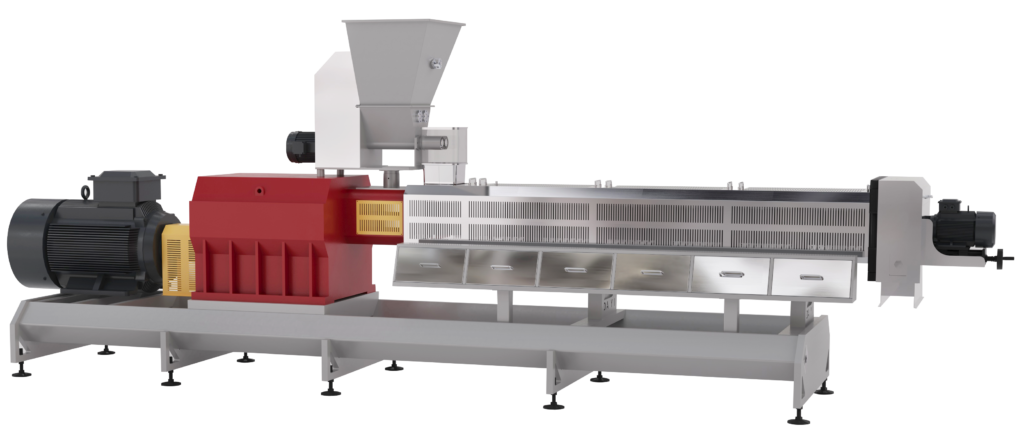
Surging—an inconsistent flow rate that shows up as fluctuating die pressure, motor load, or product dimensions—is among the most common extruder faults. Roughly ninety percent of surging problems originate in the feed and transition sections, yet operators often mistakenly adjust the metering zone . Causes include slip-stick behavior in the feed zone, a partially bridged feed throat, starve-feeding where the screw runs partially empty, or a melting zone that shifts within the transition section . The practical fix is usually upstream: increasing screw cooling or lowering the first barrel zone temperature to reduce slip-stick, stabilizing the feed rate, or lowering screw speed on a starve-fed line . A worn screw can also drive instability, and clearances should be checked before more complex changes are attempted .
Die Blockage and Expansion Failure
The die is where formulation and process errors become visible. Blocked holes, often holding scorched material or impurities, cause uneven discharge and strand breakage . Unstable die-head temperature can make material stick and accumulate; many food applications benefit from holding the die around 120 to 140°C to prevent this . Poor expansion is a related signature: puffs emerge hard and dense rather than light and crisp. The usual culprits are insufficient pressure and temperature at the die, often traceable to screw wear or moisture outside the optimal range—roughly 10 to 15 percent for dry extrusion and 18 to 25 percent for wet extrusion . Trials with oat-based formulations have encountered exactly these difficulties: die blockage, unstable material flow, and insufficient expansion before parameters were optimized .
Formulation Stress: Protein and Fiber
Adding protein or fiber to a puffed snack is not a simple substitution. High-protein content tends to reduce expansion during extrusion, producing snacks that are dense, hard, or rubbery . Protein ingredients absorb moisture differently depending on particle size, and if they take up too much water the dough may not extrude properly and can break after baking . Stiffer, protein-rich doughs also demand more power to form, requiring a balance between mechanical force and product integrity . Shape definition becomes harder to control, and fine protein powders can bridge in the hopper, disrupting feed consistency . Fiber presents a parallel challenge: oat-based trials showed that high fiber content requires careful optimization of yield and processing conditions to achieve an acceptable puffed structure .
Moisture, Temperature, and Texture Defects
The interaction between barrel temperature, screw speed, and moisture determines whether a snack expands or collapses. Higher barrel temperatures and screw speeds generally improve texture by reducing hardness and density while increasing expansion, whereas excessive oil content has a strongly detrimental effect: one study found that increasing oil from 5 to 10 percent reduced specific mechanical energy from 229.5 to 68.2 Wh/kg and drove hardness from 67.9 N to 466.9 N . In stick-shaped snack production, overly soft dough can warp, flatten on the conveyor, or stretch undesirably, while excessively high extrusion pressure can deaerate the dough and worsen mouthfeel after baking . These are not independent variables; they must be tuned together.
Oil Quality and Oxidative Defects
For fried or oil-sprayed puffed snacks, lipid deterioration is a persistent quality risk. Frying oils subjected to repeated high-temperature exposure undergo hydrolysis, thermal oxidation, and polymerization, producing volatile aldehydes, ketones, and off-flavors . Carbonyl value, peroxide value, and acid value are the conventional indicators of this deterioration. In one study of puffed potato starch chips, the addition of beeswax to the frying medium increased acrylamide content from 57 μg/kg to 97 μg/kg, illustrating that changes to the frying system can have unintended consequences beyond texture . Oil uptake is another concern: chips fried in oleogel with rice bran wax absorbed 17.7 percent less oil than the control, but the sensory and safety trade-offs require careful evaluation .
Changeover and Sanitation Pressure
Finally, the operational side of puff production introduces its own failure modes. Inefficient changeovers between products lead to lost production time, and sanitation requirements add further downtime. Modular tooling for dies and cutters, quick-release hoses and connectors, and documented standard operating procedures can reduce waste and delays . Hydraulic barrel openings on some extruders allow fast access to screw profiles for cleaning or adjustment without lengthy disassembly, addressing one of the more time-consuming maintenance tasks on a snack line .
None of these problems has a single fix. Surging points to the feed zone, dense puffs point to moisture or die pressure, and hard texture may reflect protein load or oil level. The extruder is a system, and the most reliable path to stable production is to treat feeding, moisture, temperature, formulation, and finishing as linked variables rather than isolated knobs.
 English
 Russian
 Spanish
 Italian
 Arabic
 Portuguese
 German
 French
 Japanese
 Moroccan Arabic
 Persian
 Belarusian