
Abstract
Instant rice, also known as pre-cooked or quick-cooking rice, is a convenience food designed to significantly reduce preparation time while delivering a product that closely resembles freshly cooked rice. The global ready-meal market continues to expand, with instant rice gaining prominence across tourism, military, and fast-food sectors due to its minimal preparation time of 3 to 5 minutes and extended shelf life . This article provides a comprehensive overview of the processing technology of instant rice, examining the fundamental principles, key processing steps, and emerging innovations that shape product quality.
1. Introduction
The transformation of raw rice into an instant product involves substantial molecular reorganization during pre-cooking and drying processes. These treatments fundamentally alter starch crystallinity, amylose-amylopectin proportions, and functional properties, which ultimately determine rehydration characteristics, texture, and sensory attributes of the final product . The primary challenge in instant rice production lies in balancing three competing objectives: rapid rehydration, acceptable texture comparable to freshly cooked rice, and preservation of nutritional quality.
Two major processing approaches dominate the industry: the traditional alpha-conversion process for whole-grain instant rice and the extrusion-based process for reconstituted or fortified rice products. Each approach presents distinct advantages and challenges, with ongoing research seeking to optimize both methodologies.
2. Quality Determinants in Instant Rice Production
Before examining specific processing methods, it is essential to understand the key factors that influence instant rice quality. The selection of rice variety is a critical starting point, as different cultivars exhibit markedly different rehydration properties. Jasmine rice, for instance, has been found particularly suitable for instant rice production due to its quick rehydration characteristics .
Beyond variety, the primary quality parameters affected by processing include:
- Rehydration rate and ratio: The speed and extent to which dried rice absorbs water and returns to an edible state
- Textural properties: Hardness, stickiness, and overall mouthfeel relative to freshly cooked rice
- Nutritional retention: Preservation of bioactive compounds and starch functionality
- Appearance: Grain integrity, color, and visual appeal after rehydration
The development of micro-fissures, leaching of starch granules, and interactions between starch and non-starch macromolecules play important roles throughout the preparation process . Understanding these phenomena enables processors to optimize conditions at each stage.
3. Conventional Alpha-Conversion Processing for Whole-Grain Instant Rice
The traditional method for producing whole-grain instant rice relies on a multi-step process that converts raw rice starch from its native crystalline form (beta-type) to a gelatinized, readily digestible form (alpha-type). A patented process developed by Kanemoto et al. exemplifies the sophisticated approach required to produce high-quality instant rice while maintaining grain integrity .
3.1 Raw Material Preparation and Primary Immersion
The process begins with milling brown rice to remove a controlled proportion of the bran layer. The milled rice then undergoes a primary immersion step to allow controlled water absorption. This hydration is crucial as it prepares the starch structure for subsequent gelatinization while minimizing grain breakage during later processing stages.

3.2 Primary Alpha-Type Conversion
During this step, at least the surface layers of the rice grains are converted to the alpha-structure through steaming or cooking. This partial gelatinization serves multiple purposes: it allows nutrients such as vitamin B1 and minerals from residual bran to permeate into the starch, and importantly, the protective effect of the residual bran layers prevents surface cracking during conversion .
3.3 Preliminary Drying and Final Polishing
Following primary alpha-conversion, the rice undergoes preliminary drying to a moisture content of approximately 22–24%. This controlled drying increases the strength of the gelatinized surface layers, making the grains sufficiently robust for the subsequent final polishing step—a key innovation that distinguishes high-quality instant rice production from simpler methods .
3.4 Secondary Immersion and Complete Alpha-Conversion
After polishing, the grains undergo a secondary immersion and a second alpha-type conversion step that completely gelatinizes the core portions. This two-stage approach is critical because the strengthened surface layers from the preliminary drying prevent cracking during complete gelatinization. Cracking would otherwise lead to starch leaching, nutrient loss, and broken grains in the final product .
3.5 Separation and Final Drying
The completely gelatinized rice is then separated into individual grains and subjected to final drying. The two-stage process ensures that surface cracking is prevented during this final drying step, producing intact grains that maintain their appearance and resist breakage during consumer preparation .
4. Alternative Processing Approaches
4.1 Pressure Cooking and Freeze-Drying Combination
Recent research has demonstrated that combining pressure cooking with freeze-drying offers a novel approach for producing instant rice with superior quality attributes. This method, when applied to pigmented rice varieties, preserves starch crystallinity while maintaining bioactive compounds .
For black rice varieties such as Jao Kham Hom Maejo 1A (M1A), pressure cooking for 4 minutes followed by freeze-drying at -20°C for 12 hours effectively preserved starch functionality while retaining high levels of bioactive compounds, including total phenolics, anthocyanins, and antioxidant activities . Structural analysis using X-ray diffraction confirmed that this thermal process initiated partial starch gelatinization while maintaining amylose-amylopectin crystallinity at approximately 26%—a finding with significant implications for glycemic response moderation .
4.2 Enzyme Pretreatment
Enzymatic treatment represents another promising innovation in instant rice processing. Pretreating cooked rice with α-amylase partially hydrolyzes starch, altering the structure and reducing excessive starch retrogradation while enhancing grain porosity . This modification promotes faster water absorption during rehydration.
Research has shown that α-amylase pretreatment significantly enhances swelling rate, volume expansion, and rehydration ratio of instant rice. When combined with freeze-drying, this approach produces instant rice with notably faster rehydration rates compared to oven-dried samples . The Peleg model has proven effective for predicting water absorption patterns across different drying methods and hydration conditions .
5. Extrusion Technology for Reconstituted Instant Rice
An alternative approach to whole-grain processing involves extrusion technology, which uses rice flour or broken rice as the primary raw material to produce reconstituted instant rice. This method has gained traction due to its efficiency and ability to incorporate nutritional fortification.
5.1 Extrusion Processing Principles
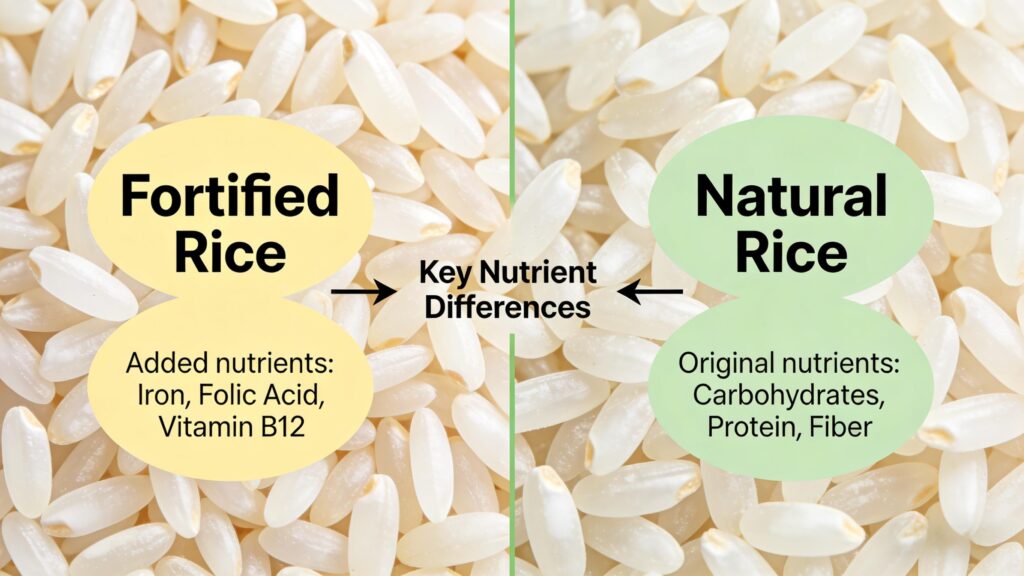
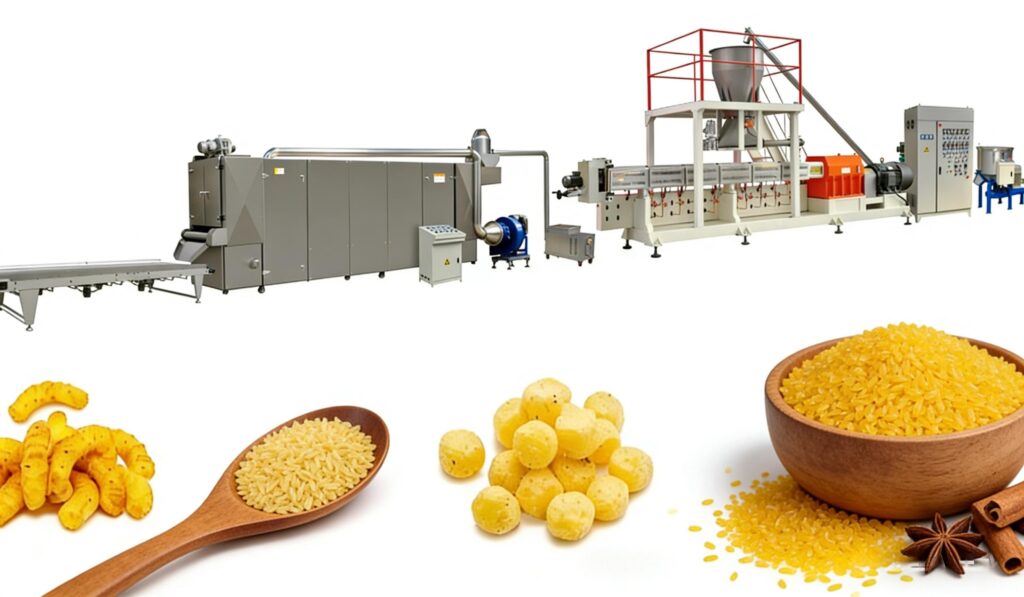
The extrusion process involves mixing rice flour with water and optional additives (such as vitamins and minerals), then passing the mixture through a twin-screw extruder. The combination of heat, pressure, and mechanical shear gelatinizes the starch and forms rice-shaped kernels . After extrusion, the product is dried to achieve the required moisture content.
This approach offers several advantages:
- Efficient utilization of broken rice and rice bran
- Precise control over final product properties through formulation
- Ability to fortify with micronutrients (vitamins, minerals)
- High automation and continuous production capability
5.2 Equipment and Production Lines
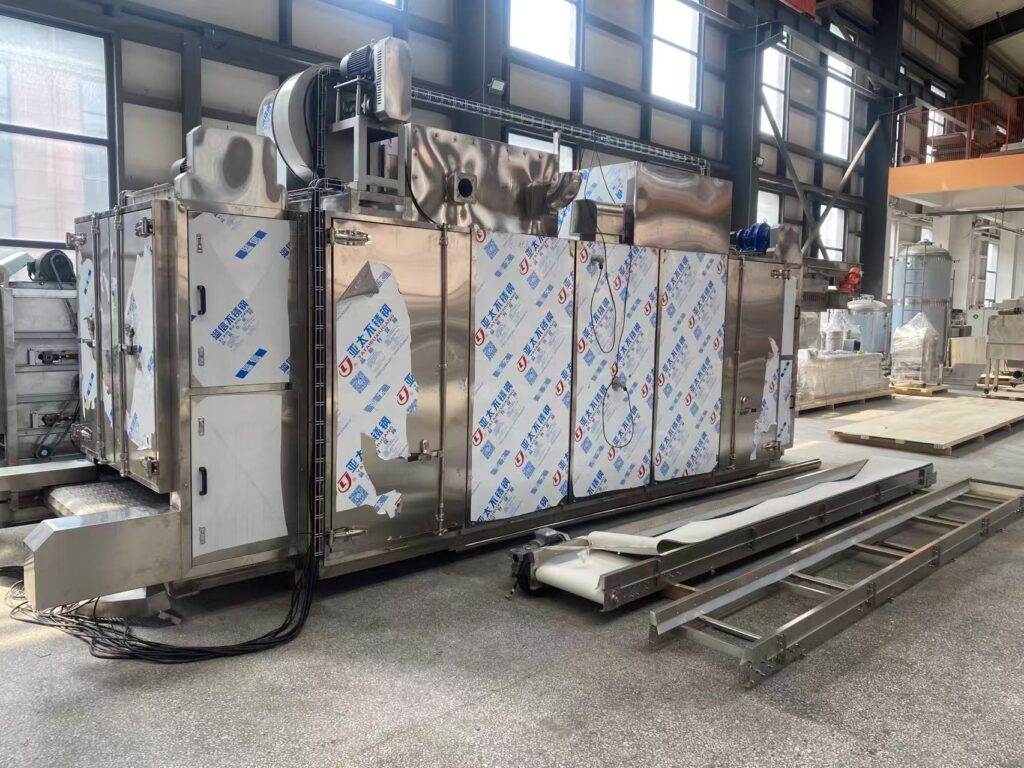
Modern instant rice extrusion lines typically include mixing equipment, twin-screw extruders, air conveyors, drying ovens, and packaging systems. Production capacities range from 150 kg/h to over 1000 kg/h, with power consumption varying by scale . The extrusion process can be adapted to produce both instant rice that rehydrates to whole grains and instant rice porridge products .
6. Drying Methods and Their Impact on Quality
Drying is perhaps the most critical step in instant rice production, significantly influencing rehydration properties, texture, and nutritional retention. Each drying method affects food structure and bioactive stability through distinct mechanisms .
6.1 Hot-Air Drying
Hot-air drying is the most economically viable method for commercial production. It forms protective carbohydrate-protein matrices while inactivating degradative enzymes. However, higher temperatures may compromise heat-sensitive compounds, and the resulting instant rice typically shows lower porosity and slower rehydration rates compared to other methods .
6.2 Freeze-Drying
Freeze-drying offers superior preservation of both structure and bioactive compounds by limiting molecular mobility, enabling direct sublimation, and maintaining consistently low temperatures . The process creates highly porous structures with bulk density below 0.28 g/cm³ and porosity exceeding 56%, facilitating rapid water absorption during rehydration . However, its high energy consumption and cost present commercial limitations .
6.3 Vacuum Drying
Vacuum drying offers a middle ground, enhancing preservation through reduced oxygen exposure and lower temperatures compared to hot-air drying. It provides better retention of bioactive compounds than hot-air drying while being more economically viable than freeze-drying .
7. Innovations and Future Directions
The field of instant rice processing continues to evolve, with several emerging trends:
Starch Structure Preservation: Understanding how processing parameters affect starch macromolecular structure is critical for balancing rehydration speed with nutritional quality. Research shows that pressure-cooking at 4 minutes followed by freeze-drying can preserve resistant starch content at approximately 6.7% while maintaining antioxidant activity .
Bioactive Compound Retention: For pigmented rice varieties, preserving heat-sensitive anthocyanins remains a significant challenge. Traditional thermal processing often degrades 45–80% of anthocyanins due to their heat sensitivity above 70°C . Novel processing approaches that minimize thermal exposure while achieving adequate gelatinization represent a key research direction.
Glycemic Response Considerations: As consumer awareness of glycemic index grows, instant rice products with higher resistant starch content and moderate glycemic response are gaining attention .
8. Conclusion
The processing technology of instant rice has evolved from simple cooked-and-dried methods to sophisticated multi-stage processes that balance rapid rehydration with product quality and nutritional preservation. The conventional alpha-conversion approach with its two-stage gelatinization process produces high-quality whole-grain products, while extrusion technology offers efficient reconstituted product alternatives.
Emerging innovations—including enzyme pretreatment, pressure cooking, and freeze-drying combinations—are pushing the boundaries of what instant rice can achieve. The selection of processing parameters must be tailored to the specific rice variety and desired product characteristics, with careful attention to starch structure, bioactive preservation, and rehydration kinetics.
As consumer demand for convenient, nutritious, and minimally processed foods continues to grow, the instant rice industry will likely see further innovations in gentle processing technologies and product formulations that deliver both convenience and quality.
 English
  Russian
  Spanish
  Italian
  Arabic
  Portuguese
  German
  French
  Japanese
  Moroccan Arabic
  Persian
  Belarusian